Showing posts with label benny and the nats. Show all posts

Sunday, July 28, 2013

2+2=5

All hail the birth of Prince George of Orwell, third in line to the throne of Airstrip One, Defender of the faith of the Church of England and Patron Saint of women's magazines, lazy newspaper editors and the vacuous live cross-promotional soapbox theatre sock puppets of TV news.

# We have always been at war with *CLASSIFIED*:

The US refuses to name its clear and present antagonists in the War on Terror on the grounds of national security.

# Truth is Treason

Nicky Hagar reports on Stuff that the NZ Defence Force, GCSB and SIS were among the people tracking and tracing freelance journalist Jon Stephenson in Afghanistan:
An internal Defence document leaked to the Star-Times reveals that defence security staff viewed investigative journalists as "hostile" threats requiring "counteraction". The classified security manual lists security threats, including "certain investigative journalists" who may attempt to obtain "politically sensitive information".

The manual says Chief of Defence Force approval is required before any NZDF participation in "counter intelligence activity" is undertaken.
What lengths would the NZDF go to in order to save face on the basis of national security? Would they nobble a civilian jury, for example? I have met Defence Force PR people in the past. It's a safe bet that what they know about ethics could be written on an SD card in crayon.

# Hard is Soft

Rachel Smalley loses her 2012 Loki Award for the cross-promotional fluff that has infected The Nation. Who gives a rat's fat crack about X Factor on an alleged hard news program?

# Arbeit Macht Frei

The welfare reforms continue to bite. It's early days yet, but cracks are beginning to show. If the UK experience in outsourced welfare is anything to go by, big problems should be evident in time for next year's election.

Thursday, January 24, 2013

Giving the new leaf at Treasury the flick

The jury's still out on the newish head wonk at Treasury, but the evidence is not looking good. In fact, the only leaf of Treasury statements I'll be turning with anticipation will be the ones written on toilet-grade paper. And it's big thanks to selective Welfare Hawk Lindsay Mitchell for pointing it out to me.

Lindsay is upset, as usual, at how much is spent on solo Mums, etc. She has the latest Treasury paper to prove it too. The report is all fire and brimstone for the slackers, even when the figures show that there's not much of a problem. As a percentage of GDP, "Working Age Welfare" is lower now than it was in the 1990's after Shipley's benefit cuts. By all measures, it has never been less attractive to be on welfare.

What about the great grey gorilla in the room though? What about that colossus of welfare that dwarves these Liliputian expenses? What about Superannuation?

Well, it's all peaches and cream for the subjects in the corresponding report, titled The Future Costs of Retirement Income Policy, and Ways of Addressing Them. No moralising or sneering at these welfare recipients. There's lots of furrow-browing over poverty levels in the elderly, manifesting in colourful decoy patterns such as (I kid you not) the Living Standards Framework Pentagon (pg. 9).

The "Working Age Welfare" report didn't waste time discussing any of their subject's poverty levels, polygonal or otherwise.  It's conclusions were all based on historical figures, with few projections. The Super report was the antithesis, all fluffy futures and sweet FA historical context.

The most amazing thing about this panglossian brighter future was that, unlike Lindsay's Bennie Bash, nowhere in this report does it state how much Superannuation costs. It's mentioned obliquely as a percentage of GDP well down in the volume, and that's the last they'll look at that. I thought I must just have been high, so I searched the document for "$" and then "dollars". Apart from mention of the cryogenically-frozen Cullen Fund, no mention of actual dollars.


You have to go to Treasury's Budget page to get a straight answer to compare Lindsay's bad apples to the honest, salt-of-the-earth good old apples. Lindsay's horrified by the $13 billion a year "Working Age Welfare" quoted. For the 2010/11 year, the Superannuation was $8,822 million (not including SuperGold scard spending). The same sworn document says the "Working Age Welfare" budget was $4,878 million.

Even with the Working For Families bloat (which is welfare for the kids, not the working age), these costs are capped. All the indicators on the affordability of Superannuation point the wrong way. Yet it has never been a better time to retire, and that's not counting the other perks like the Gold Card millions or the ginormous chunks of Health dollar.

The game is rigged and the boomers got away with it. And no amount of sophistry and ignorance out of Treasury will change that.

Monday, October 15, 2012

Paula Bennett's Big Backdoor Kiosks

Usually when this government faces large font headlines, Paula Bennett is wheeled out with some outrageous new welfare policy to distract the media pack. The scale of embarrassment that John Key is facing over the Kim Dotcom headshot was too large to surmount with this usual tactic. After Keith Ng's moderately large but elegantly moderated MSD data dump last night, Paula Bennett will be lucky to keep her job.

A security hole that makes the ACC debacle look puny in comparison will do that. Hell, it makes the police INCIS computer scandal under the Nineties Nats look like a blip. I expect there's a small IT boom going on in Wellington right now as holes of various sizes are patched. Paula Bennett is having a crash course in jargon such as firewalls, partitions and privacy.

She owns this mess just as John Key owns his Dotcom vom (seriously, how come the only black spots for the security cams in the shiny new Defence Citadel are the rooms John Key walks into?). The new kiosks were introduced under her watch. They were introduced to cut staff levels, in order for National to reach their hell-for-leather 2015 surplus.

An advocacy group even warned the MSD formally and informally, after their photo op launch for the kiosks a year ago. One of my Facebook circle witnessed the event. The MSD were told and nothing was done. It sounds like the CERA re-build might be another multi-billion dollar government budget with its nuts waving in the wind with the same system. Bang goes any trust in inter-governmental data sharing.

There's a lot of outrage out there. The very vulnerable children that Paula Bennett has said she wanted to protect have had their most intimate details available to anyone who can wave a mouse down at the local WINZ office. Not to mention the read, write, execute access that left a possibility of fraudulent use that would make a Nigerian scammer blush.

The one day that there's a government scandal, and for once Paula Bennett is silent. Unless Key has set the bar lower than worm's limbo competition, there's a fair chance that Bennett is not long for the cabinet table.

Wednesday, August 29, 2012

Paula Bennett announces Purity Test for Unemployed


Welfare Minister Paula Bennett today announced that beneficiaries will have to undergo a Purity Test from July next year. Clients who fail the test will face loss of welfare payments, compulsory re-education or a range of other sanctions.

The Mazengarb Test, as it will be called, is a type of morality index that was first developed at the Massachusetts Institute of Technology in 1980. The Mazengarb Test is a New Zealand adaptation compiled with the assistance of focus groups, church leaders, police, Whanganui city councillors and other leading voices of the community.

"Instead of taking a piecemeal approach to state interference in peoples' lives - limiting welfare to the DPB based on child bearing, drug testing and so forth - National Mazengarb Testing will revolutionise how the government tells people how to live," said Paula Bennett at a press conference announced at short notice this afternoon. "Loose morals will no longer be tolerated like they were when I was a young Mum," she said.

Bennett took only a few questions after she read out the statement. She refused to give any more details on the Mazengarb scheme, and denied the accusation that this announcement had anything to do with the latest inequality rankings or Children's Commissioner's report into child poverty.

Sunday, August 28, 2011

Adventures of Super Key Man

Is it a shag? Is it a glider? No, it's Super Key Man to the rescue!

By day, John Key is a retired currency speculator who likes to keep fit by swimming lengths in his Parnell mansion's swimming pool full of Krugerands. By night, he is protector of the rich and entitled; he is... Super Key Man!

Last week, you will recall that Super Key Man was trapped by those dastardly fiends, DPB Mum and her side-kick Delinquent Unemployed Hoodie Boy. DPB Mum threatened to rape Super Key Man in order to get pregnant and stay on the benefit, while Delinquent Unemployed Hoodie Boy forced alcohol and cigarettes into him.

Stay tuned for another exciting episode of... The Adventures of Super Key Man!

Super Key Man: Ugh! This behaviour is morally unacceptable and fiscally reprehensible. New Zealand will never catch up to Australia while you're free, DPB Mum and Delinquent Unemployed Hoodie Boy!

DPB Mum: That's what you think, Super Key Man. Hang on, what's this scar on your scrotum? Gah! You've had the snip! I'll never get preggers with you, Super Key Man!

Super Key Man: That's right, DPB Mum. I have taken personal responsibility of my testicles, just as the Welfare Working Group Justice League recommends for you too.

Super Key Man reaches into his utility belt.

Super Key Man: I may have left my Compulsory Hysterectomy Laser at home but... take that!

Something whizzes out of Super Key Man's hands at DPB Mum and Unemployed Hoodie Boy.

DPB Mum: BLAMMO! You've stabbed us and our boy with stored value debit cards!

Super Key Man: Yes. Lucky I always carry my Paula Bennett Slapper cards with me at all times.

DPB Mum: You may have won this round, Super Key Man. But we'll be back to fight you another day. Come on, Delinquent Unemployed Hoodie Boy. Let's limp off to the pub and drown our troubles.

Well done, Super Key Man! Stay tuned next week, when Super Key Man takes on his most dangerous foes yet; Domestic Violence and Suicide!

Monday, August 15, 2011

No food stamps for old people?

Bernard Hickey has picked up yesterday's post and run with it in an unexpected direction. It seems he's a fan of food stamps, a program that is working so well in America, one in 8 people are now using them. Whatever the hazards of the system, it works well as a poverty indicator.

In fact, the scheme should be introduced to pensioners too, to protect the Old Ones from the TAB, pokies and the RSA, sez Bernard.

True, my Old Mum does like a flutter on the races, and her favourite free to air channel on the old tube is Trackside. But it gives her solitude something to look forward to, because frankly there's not much else in the day. Similarly, I have no problem with Old Ones getting pissed in the middle of the day. I just wish they wouldn't drive as well. Personally, I'm an after 6pm drinker myself, but each to their own.

I'm closer to Bernard's mindset on the pokies thing, though. Horses and booze are as harmless as phone-up psychics and homeopathic anti-wrinkle creams to the Shopping Network Oldsters, but pokies is different. These things are designed to rob people blind. In spite of the facade of charity grants, pokies are run by a hive of scum and villainy preying on the desperately vulnerable.

Big Ups to Bernard Hickey for pulling the relevant stats on benefit numbers:
Pensioners are New Zealand's biggest beneficiaries. There are over 580,000 people aged over 65 who received over NZ$8.8 billion worth benefits in the financial year just completed. See more here at Jonathan Barron's detailing of the Social Welfare budget here.
 Needless to say, John Key was lying by a large quantum yesterday when he said:
"Currently, 328,000 people are receiving a benefit – more than 10 per cent of the entire working age population."
 If he wasn't lying, Key's speech would have read:
"Currently, 908,000 people are receiving a benefit – more than 20 per cent of the entire population."

If John Key was as honest as he was smiley, he would have gone on to say:
"The 580,000 beneficiaries, who cannot be named and will not be harmed, enjoy more Health dollars per capita and more free public transport per capita than any other sector of society. My National government has backed your vested interests by changing the rules and allowing the 580,000 beneficiaries to travel or even live overseas without losing a cent of entitlement."
  There's one hell of a fiscal creep.

Sunday, August 14, 2011

No Country for Young Men

After having a read of John Key's welfare speech to the converted, I consider riots in NZ more likely than yesterday. These Nat plans can only ratchet up public tensions further.

I'll get to the competent adult / young person support provider thing, as well as the food stamps, shortly. But first, I want to discuss John Key's dictionary definitions.

John Key certainly has a strange definition of government benefits. "Currently, 328,000 people are receiving a benefit – more than 10 per cent of the entire working age population," sez Key. The Super Gorilla in the room, National Superannuation, is not considered a benefit, even if it is a government transfer just like the DPB or Special Youth Benefit, which John Key is bashing here.

Either I'm thick or don't know the right question to Google or whatever, but I cannot find a direct answer to how many people are currently receiving NZ Superannuation. Not even a ballpark figure. The latest New Zealand Income Survey (June 2010) gives an indication of not only the size of the geriatric iceberg, but how skewed Key's selective benny bash truly is:


Of the 48,100 more people claiming a benefit in the year to June 2010, 36 percent of the new intake was over 65 years old. The 2009 Income Survey showed 41 percent of the increase in government transfer recipients was from an extra 13,900 over-65s. From 2009 to 2010 alone, that's a 25 percent increase in new Superannuation payees. It's going to get a whole lot worse as those Boomers retire.

To drive the point home further, there's always Dim Post's old Chart o' the Day from a while ago to remind you what Key's ignoring:


Now, Dagg bless Phil Goff's cranky old dad and all, still loudly ticking at 90. But unless Bruce Goff is an idiot, he would have been on National Super for the last 25 years. I don't wish him ill, it's just one example of how wilfully ignorant John Key is on the demographic nightmare NZ is putting off because Mr Smile and Wave is too chicken.

It's no wonder that John Key is cherry-picking from the Welfare Working Group's report, myopic as it was from ignoring those precious old person votes which John Key has promised not to antagonise.

But what lousy cherries he has picked. Targetting the 16 and 17 year old's Special Benefit is a case in point. Yeah, they're vulnerable and need support more than most. After all, if they can't live at their parents' homes for whatever reason, there's a certain natural level of distrust to authority figures to take into account.

The cure according to Key is to take the benefit off them and hand their basic budgeting to others. The Young Ones must be patronised:
They need a competent adult to help them manage their money. They need a competent adult to help them meet the obligations and responsibilities that come with receiving financial assistance from the State.

And they need a competent adult to help raise their aspirations above the here-and-now. That is why we are going to fund these support providers to be the competent adults in these young people’s lives – to provide intensive case-management and mentoring support.
These "support providers" haven't been quite worked through yet. It might be the local Catholic priest or an overworked WINZ case manager or a private sector corporate welfare scheme based on the Wisconsin model. Whatever. I reckon they'll be about as successful as John Key's boot camp experiment Fail.

It's not just the Young Ones who should be worried. The level of state intrusion in benficiaries' lives is set to worsen:
Instead, we will have a much more managed system of payments, with the young person’s support provider, or MSD in some cases, paying bills on their behalf and helping them manage within their budget.

While there is still a lot of detail for officials and ministers to work through, we envisage that:
  • some essential costs, like rent and power, will be paid directly on the young person’s behalf
  • money for basic living costs like food and groceries will be loaded onto a payment card that can only be used to buy certain types of goods and cannot be used to buy things like alcohol or cigarettes
  • and that a certain, limited amount will be available for the young person to spend at their own discretion.
You do not unleash infrastructure of such complexity unless you intend to test it before widening it to others.The Young Ones are guinea pigs for a new regime of Food Stamps for all beneficiaries (excluding the Super voters, no doubt). Alcohol and tobacco for poor people bad! Pies and ice cream good!

National's paternalism is more likely to fuel a backlash than inspire fomenting youth to comply with their minders. Because, no matter how much Key tries to hide it, the jobs just aren't there.

The Young Ones are easy fodder for the blue rinse brigands, in much the same way as farmers are Labour's current scapegoats. Farmers are predictable protesters though, always with a strong "Let the Tractor do the Talking" motif. The Young Ones aren't quite as constricted in their tactics, as the last week in London has shown.

Epilogue:

Who is making hay under John Key? According to that Income Survey, it's not the average income earner:
Median weekly income from all sources fell slightly, down 1.7 percent to $529 (non-significant).
It's not the average wage slave:
Between the June 2009 and June 2010 quarter, there was a slight decrease in the proportion of people earning wage and salary income down 0.6 percentage points to 53.5 percent.

It's those bloody Baby Boomers:
Significant increases in median weekly wage and salary income since the June 2009 quarter were recorded for only two age groups:
  • 50–54-years (up $61 to $880)
  • 65 years and over (up $66 to $535).
Uh huh. As at June 2010, the median weekly wage and salary income is below that of the median Superannuitant. Needs based welfare indeed.

Friday, September 24, 2010

The outlaw Paula Bennett

Increasingly, it seems that Social Welfare Minister Paula Bennett considers herself above the law. There was her leaking of beneficiary details which has led to a complaint being made to the Privacy Commissioner.  Shroff concluded that the complaint against Paula Bennett had "sufficient substance" and referred it to the Director of Human Rights Proceedings.

No Right Turn has shown the contempt with which the minister treats Official Information Act requests:
Paula Bennett does not appear on the table because she refused to cooperate with the project, offering various excuses before ultimately claiming that compiling the data would not be in the public interest. Her refusal is now the subject of a complaint to the Ombudsman.

John Drinnan now reports that Bennett successfully wrangled an extension to the time limit on BSA complaints:
More obscure than the sex complaints - but in many ways more intriguing - was the BSA decision from an obscure interlocutory hearing that bent the deadline for a complaint by Social Development Minister Paula Bennett.

Drinnan goes on to note a motive for this unique relaxation of the rules:

But a parliamentary source said that the Bennett complaint had support elsewhere in Cabinet - and there was more at stake than one story on 3 News. National believed that the complaint had a good chance of being upheld and reflected concern about TV using what was regarded as flimsy source material from social media sites such as Facebook.

TV3 look like appealing and fair enough. Join the queue. Just because the Nats are stacking their mates in various tribunals, it doesn't mean they can break the rules because the minister is a slack bastard. And good luck trying to suppress social media. News is three quarters corroborated gossip anyway.

Monday, August 23, 2010

Frozen pies do not grow

So much for growing the pie:
Researcher Andrew Coleman found that in 2006 40-year-old Kiwi men were, on average, earning just 96 per cent of what men of the same age earned in 1981 in real dollar terms. By comparison, Australian 40-year-olds were earning 31 per cent more. 

Although NZ men are averaging less than what a 40 year old earned in 1981, real housing and other living costs have not remained stagnant. Making ends meet has never been harder.

Meantime, in Brewerland:
Newmarket Business Association chief Cameron Brewer said the vacancy rate on Broadway was as bad as the early 1990s, when unemployment in New Zealand hit 11 per cent.

Wellington looks similar, with vacant shops and land through the gentrified suburb of Thorndon through Lambton Quay and up Willis St.

And finally, Johann Hari at the Independent looks at the voodoo of management consultancy:
He worked to a simple model, which is common in the industry. He had to watch how a workforce behaved for a week – and then tell the company's bosses, every time, that they had 30 percent too many staff and only his consultancy could figure out who should be culled.

So bring it on, Paula Benefit. I'll be waiting with a gun and a pack of sandwiches.

Saturday, August 14, 2010

Bad oral exams

From The Onion, but could have just as well have been Paula Benefit or the Welfare Working Group:
With unemployment at its highest level in decades, the U.S. Department of Labor issued a report Tuesday suggesting the crisis is primarily the result of millions of Americans just completely blowing their job interviews.
I also understand that there's a prostitute shortage in Auckland. Perhaps the Nats can move a few DPBers into the Game. Night jobs don't require day care, eh. It's win-win isn't it?

Wednesday, August 11, 2010

Stabbing that graph


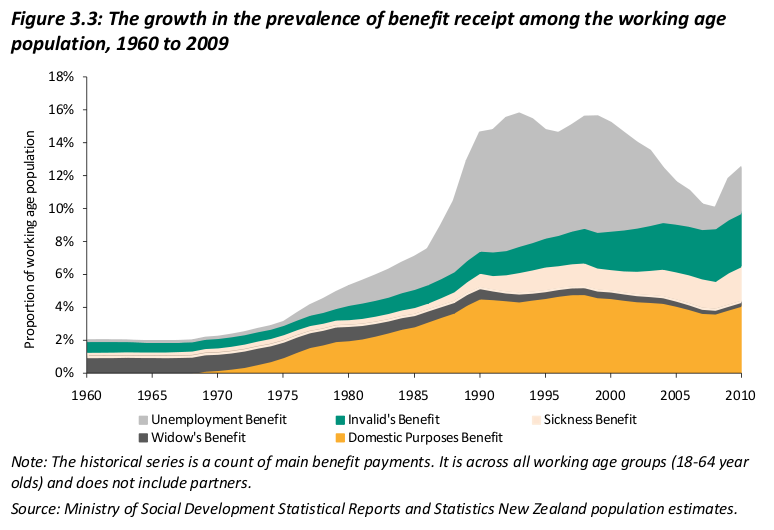
I'm a bit disturbed at the language framing the welfare landscape in the text of the Welfare Working Group's interim report. Maybe the whole enterprise is flawed anyway. In much the same way Jim Anderton hobbled the Law Commission's review of drug laws by ignoring alcohol and tobacco (as well as taking a conservative interpretation of United Nations obligations), the Welfare Working Group has large blind spots contained within its terms of reference. Working For Families and Superannuation are off limits.

All the same there are some nuggets of interest within the document. I'm going to take a few stabs at that graph above.

First up green and pink, the Invalid and the Sickness beneficiaries. There's a big kink in all the trends smack bang on 1990. The Employment Contracts Act is the obvious culprit, but I would also include the Health and Safety legislation as an accomplice to the fallout. OSH was the safety nazis' second big victory, following the Smokefree laws passed in the Fourth Labour government's dying breaths.

Up until the Health & Safety in Employment legislation in 1992, it wasn't possible to classify someone as a health & safety risk. Sickness and invalid benefits, static prior to 1992, begins its inexorable growth with this change in risk perception. If any blame is to be placed on the level of sickness and invalid beneficiaries, it belongs with old Nat policies.

Another problem was the rise in employment and temping agencies, middlemen who became the strict gatekeepers to many jobs. It was no longer sufficient to be good at something. One now had to be a self-promotion expert in order to gain so much as a foot in the door in this new world of American management theory.

Ever more complex tests were devised to sift through employment risk aversion strategies; Myers-Briggs tests, credit and police checks. Deeper and deeper intrusions into personal lives excluded more and more potential candidates, regardless of their essential competency for the position. Little wonder a subclass of square pegs found themselves too sick for this system, invalidated by the meaningless rigid compliance.

OK, let's turn now to those orange DPBers. It's a bit disingenuous of the Welfare Working Group to preach 1960 as a baseline. 1970 is where it all changed. In short, fem lib happened. The Pill became available. Germaine Greer published The Female Eunuch. NZ women slowly embraced the ability to choose their own destiny and not just as the disposable chattels of men.

The Domestic Purposes Benefit gave women and children financial independence to leave abusive men, or raise the kids if the men buggered off to Australia. Coming from a family where two generations of Mums and kids have been kicked out of home by the fathers, the DPB is a pretty important landmark as far as I see it.

It is also worth noting that current DPB levels are lower than when Welfare Minister Paula Benefit was on it in Bolger's 90's. Danyl at the DimPost also fairly reckons that Labour's policies such as the in-work tax credit did more to lower the DPB stats than any Nat policy ever did.

Finally, the grey unemployed bloc. 1975 was the first big blip, around the time of Britain's entry into the Common Market. Throw in an oil shock or two, some scary-ass inflation and Rob Muldoon, and there's a pretty steady rise in the unemployed. Not even the start of weekend shopping in 1980 could dent the rise in jobless. Then in the mid 1980's Rogernomics deregulates everything, sending unemployment soaring as the rebalancing starts.

And it hasn't stopped. The labour force has been casualised, outsourced and sub-contracted. Even the Mother of All Budget cuts by Ruth Richardson couldn't put a dent in the stubborn rise of the unemployment numbers during the 1990's. Indeed, the Bolger/ Shipley governments seemed almost to prefer an unemployment pool of around ten percent of the workforce to assist in the downward pressure on wage inflation. Something that the Key government looks similarly relaxed with.

The safety, security and stability that the baby boomers enjoyed, where many families could afford to live on a single income, has all but disappeared from anything below the NZ upper-middle classes. Women entering the workforce, while good and necessary on equality grounds, has diluted the labour pool, helping drive down wage growth. As Elizabeth Warren pointed out in The Coming Collapse of the Middle Classes, this generation is living on much thinner margins than its predecessors.

And as DimPost points out, all this mucking about with non-valids and solo mums is dwarfed by the humongous welfare costs associated with Universal Superannuation and Working For Families. The Nats and the Welfare Working Group best bear in mind some sense of proportionality when they write up their policy recommendations. Otherwise, it might all just blow up in their faces.

Monday, August 09, 2010

Today is Monday

# Interesting chart o' the day:


From the Welfare Working Group Report. Pity the Super figures aren't included. That would have made a more accurate picture of the welfare sandwich.

# Interesting prophesy of the day:
Worst of all, some analysts warn that the failure to rein in Wall Street makes another meltdown a near-certainty. "Oh, sure, within a decade," said Johnson, the MIT economist. "The question: Is it three years or seven years?"

Johnson was part of a panel sponsored by the nonpartisan Roosevelt Institute – including Nobel Prize-winning economist Joseph Stiglitz and bailout watchdog Elizabeth Warren – that concluded back in March that the reform bill wouldn't do anything to stop a "doomsday cycle."
From Rolling Stone's Matt Taibbi.

# Cthonic Comment of the Day:
As I journeyed ever deeper into those underground passages, the strong the often-remarked scent of despair and madness that clings to Parliament became gradually stronger. I was on the point of turning back, overwhelmed by the stench, when I heard movement in front of me, and saw light.

From Scoop's Lyndon Hood.

# Creative Accounting Corner. It's a bit old but still a good read; how Harry Potter actually ended up as a $167 million loss for the studio:

Monday, November 02, 2009

Public servant paradise

Stop the presses, I've found a valid beneficiary to bash; public sector superannuation scheme recipients. While Lindsay Mitchell takes aim at drug abusing invalids beneficiaries (no, I'm not taking it personally), perhaps a look at the Labour Cost Index might show where a lot of public spending growth has gone. The trend is Billy bolded.

From the June 2004 quarter to the June 2005 quarter:
Surveyed labour costs rose 2.7 percent.
Non-wage labour costs rose 3.0 percent.
Annual leave and statutory holiday costs rose 2.9 percent.
Superannuation costs rose 7.3 percent.
Workplace accident insurance costs rose 7.2 percent.
Other non-wage labour costs (vehicles, medical insurance and low interest loans) fell 2.8 percent.
These results are final and revisions have been made to the indexes. Please see the Commentary for further details.
Biggest rises in Super and ACC.The commentary sez:
Employer superannuation costs increased 7.3 percent from the June 2004 quarter to the June 2005 quarter. This follows no change in the previous June year. The latest increase in superannuation costs was influenced by a 2.6 percent increase in salary and ordinary time wage rates.

In the public sector, superannuation costs rose by 15.2 percent, mainly due to the introduction of the State Sector Retirement Savings Scheme (SSRSS) and greater membership by teachers of retirement savings' schemes. From the June 2003 quarter to the June 2004 quarter, public sector superannuation costs decreased 3.1 percent.

Superannuation costs for the private sector increased 1.3 percent from the June 2004 quarter to the June 2005 quarter. This follows an increase of 2.5 percent in the previous June year.
From the June 2005 to the June 2006 quarter:
Surveyed labour costs rose 3.7 percent.
Non-wage labour costs rose 6.2 percent.
Annual leave and statutory holiday costs rose 7.1 percent.
Superannuation costs rose 6.6 percent.
Workplace accident insurance costs rose 4.8 percent.
Other non-wage labour costs (vehicles, medical insurance and low interest loans) rose 0.7 percent.
The two biggest rises that year were Holidays and Super. The commentary sez:
Employer superannuation costs increased 6.6 percent from the June 2005 quarter to the June 2006 quarter. This follows an increase of 7.3 percent in the previous June year. The latest increase in superannuation costs was influenced by a 3.3 percent increase in salary and ordinary time wage rates.

In the public sector, superannuation costs rose 12.3 percent, mainly due to the increase in the employer contribution rate of the State Sector Retirement Savings Scheme (SSRSS), which took effect from 1 July 2005. From the June 2004 quarter to the June 2005 quarter, public sector superannuation costs increased 15.2 percent, mainly reflecting the SSRSS, which was introduced from 1 July 2004.

Superannuation costs for the private sector increased 1.7 percent from the June 2005 quarter to the June 2006 quarter.
Can you spot the trend yet? Twenty-seven percent increases in public sector superannuation bonuses over two years and counting... Here comes another one...

From the June 2006 to the June 2007 quarter:
All labour costs rose 3.9 percent.
Salary and wage rates rose 3.2 percent.
Non-wage labour costs rose 8.1 percent.
Annual leave and statutory holiday costs rose 9.3 percent as a result of an increase in minimum annual leave entitlement.
Workplace accident insurance costs rose 9.3 percent.
Superannuation costs rose 4.2 percent.
Other non-wage labour costs (vehicles, medical insurance and low interest loans) rose 1.8 percent.
Super takes a break from blowing out the costs. This was the year that annual leave was raised from three weeks to four. The commentary explains:
Annual leave and statutory holiday costs increased 6.3 percent for public sector employees, down from the record 7.8 percent increase in the year to the June 2006 quarter. For the private sector, annual leave and statutory holiday costs rose 10.6 percent, the largest increase recorded for the private sector since the series began in the December 1992 quarter. One reason for the private sector increase being greater than the public sector increase was that fewer employees in the private sector were previously entitled to four weeks or more annual leave than in the public sector.
One thing to note about those ACC levies by the way, which in those three years have risen by 25 percent. Public sector pay level negotiations would not be nearly as affected by these levies half as much as their private sector counterparts. This is solely because public sector employers (the gummint) have the biggest taxpayer-augmented tits in the country. As for the private sector, it's much more zero sum for the workers, seeing as their smaller employers have less tit to hand around.

OK, back to the numbers. From the June 2007 quarter to the June 2008 quarter:
All labour costs rose 3.7 percent.
Salary and wage rates rose 3.5 percent.
Non-wage labour costs rose 4.1 percent.
Annual leave and statutory holiday costs rose 4.7 percent.
Workplace accident insurance costs rose 4.7 percent.
Superannuation costs rose 2.7 percent.
Other non-wage labour costs (vehicles, medical insurance and low interest loans) rose 0.3 percent.
Blah. Costs in line with the CPI. Not surprising seeing how there's a recession and an election year on the plate. KiwiSaver was also introduced, and the commentary makes an interesting observation on that:
In the four months from April 2008 to July 2008, employers reclaimed, on average, about 70 percent of their contributions to KiwiSaver schemes. In some industries, the proportion of  contributions reclaimed averaged about 90 percent, and in other industries, only about half was covered by tax credits.

That doesn't sound like a very egalitarian outcome! Anyway, on to this year. From the June 2008 quarter to the June 2009 quarter:
Surveyed labour costs rose 2.8 percent.
Non-wage labour costs rose 2.6 percent.
Annual leave and statutory holiday costs rose 0.3 percent.
Superannuation costs rose 30.8 percent.
Workplace accident insurance costs fell 2.5 percent.
Other non-wage labour costs (vehicles, medical insurance, and low interest loans) rose 1.7 percent. 
The LCI (all labour costs) indexes have been reweighted. For more information see the commentary section of this release.
Sweet Zombie Jesus in aspic, a 30 percent increase in superannuation costs. The commentary explains:
The main reason for the large increase in employer superannuation costs was the changes to employer contributions to employees' KiwiSaver schemes which took effect on 1 April 2009. Part of these changes involved an increase from 1 percent to 2 percent in employer compulsory minimum contributions to their employees' KiwiSaver schemes.
So it was the big switcheroo from tax credit to tax cut, which will be back out the door again as next year's ACC levy increase. Back to the commentary:
In the public sector, superannuation costs rose by 14.2 percent. Superannuation costs for the private sector increased 40.0 percent from the June 2008 quarter to the June 2009 quarter.
OK, public sector superannuation is a bit like the ACC story; largely unaffected by the tax cut swaparoo. Even so, the public sector still managed a 14 percent increase in super costs.

Over five years, public sector superannuation costs have risen over 50 percent cumulatively. When will the Benny bashers tame public sector superannuation? There's no PERFect storm of disapproval with this rort, just the usual easy targets.

The Benny bash is back

Walking through Wellington city, you might be forgiven for thinking that we're still in thick of recession. Willis St has vacant shops a go-go, Thorndon is awash with colourful For Lease signage, and the queues outside the WINZ office are as long as ever. However, Bill English is assuring the nation that the worst is over and it's time for all those bludgers on the sickness and invalids benefits to head back to work:
The Government is poised to implement a key election pledge requiring parents on the domestic purposes benefit to find work or training once their youngest child turns six.

Sickness and invalid beneficiaries are also in the Government's sights, with plans to make it tougher to sign up and stay on either benefit indefinitely.
It's not all stick, according to the Nats. Beneficiaries will now be able to earn an extra $20 a week before their benefits are abated. That's one hour of cleaning Bill English's non-residence in entitlement-speak, although I don't imagine many Nat MPs will be hiring me to do their dirty work.

That's right dear readers, I am an invalid beneficiary. Hire me. Yes, I'm half deaf and have a mind that is part fluffy duck, part gin trap, but the Nats think I'm up for work. Yes, I have been on the dole before and been turned down as under- or over-qualified, or just plain not-what-we're-looking-for. But, like Tolley's testicles, the Nats want to tick the boxes more often to see if I am still strange.

I tell you what, Nats. You can introduce your Benny bashing bolicy once you get WhaleOil a job and off the disability pension. Go on, he's just one man. If you can't do well with one of your own, what hope do you have with all the others apart from locking them up in jail at three times the price of an out of town MP allowance?